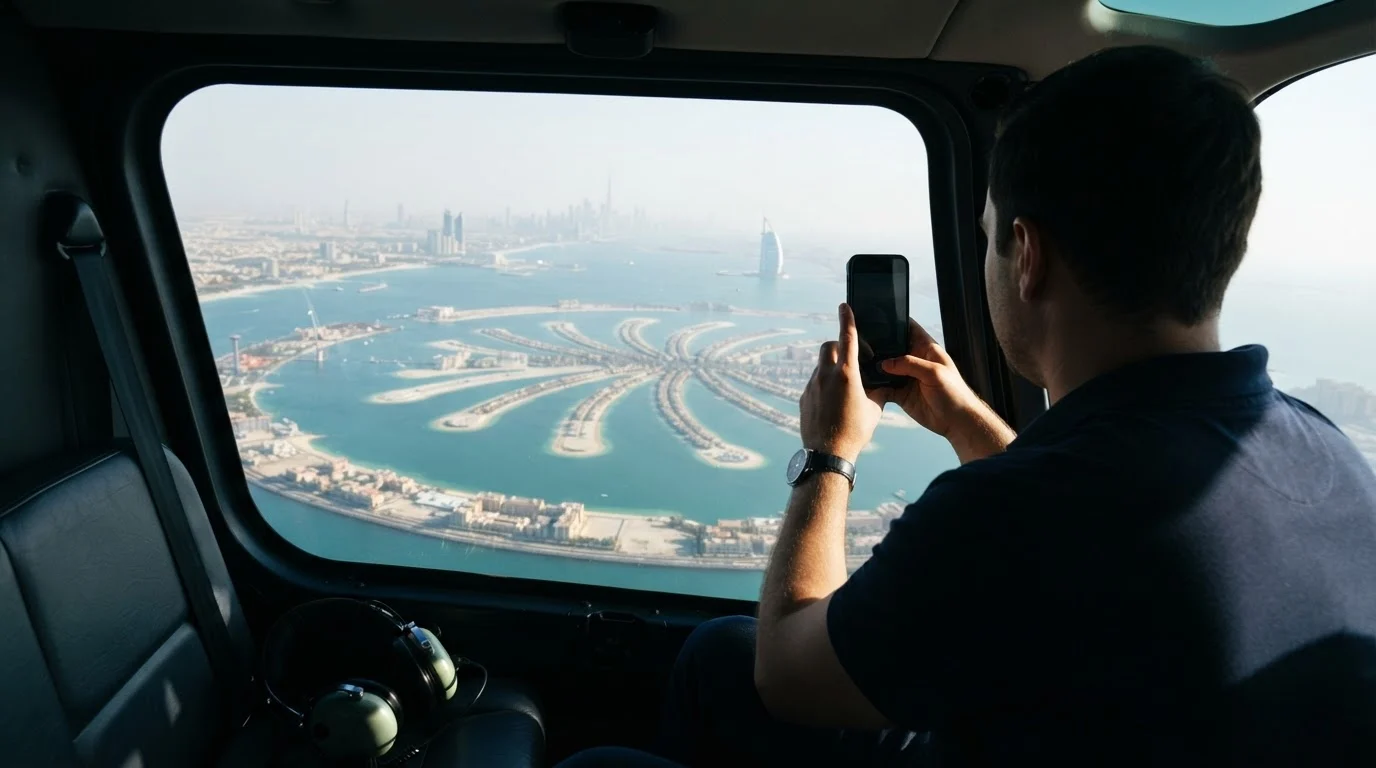
Yes, you can take photos and video on a Dubai helicopter ride, as long as your phone or camera stays inside the cabin. Every passenger sits beside a window, so good results come down to technique: lens close to the glass, dark clothing to cut reflections, small items secured, and a route chosen for the subjects you want.
Key takeaways
- Photos and video are welcome on every flight with Luxury Helicopter Tours Dubai, provided devices stay inside the cabin and loose items are secured.
- The Airbus H130 and H125 have no middle seats, so every passenger gets a window. The crew assigns seats by weight, so nobody can promise you a particular side or seat.
- Reflections are the most common problem in helicopter photos. Press the lens close to the glass, wear dark clothing and keep the screen brightness low.
- A phone is the easiest tool for most guests. A compact camera works well too, while a bulky camera with a long lens is harder to handle in a small cabin.
- Route choice decides your subjects: the 12-minute City Scapes covers the Palm, the coast, the Burj Al Arab and the Burj Khalifa, while the 25-minute City Circuit adds Dubai Marina, Jumeirah Lake Towers and Dubai Creek.
- The booking form offers three windows: 9:00 to 11:00, 12:30 to 14:30 and 15:10 to 17:00. Morning and late afternoon usually give softer light than midday.
Can you take photos on a helicopter ride in Dubai?
Yes. The company's own guidance is simple: photos and video are welcome with devices kept inside the cabin. Guests are asked to leave loose hats and scarves behind and to secure small items before take-off. That is the full rule set for photography, and everything else in this guide is technique.
The reason for keeping devices inside is safety. Anything that slips out of a hand near an opening could cause harm, which is why the crew is firm about it. In practice this means you shoot through the window glass, not around it. Plan your photos with that in mind from the start, rather than hoping for an open view on the day.
The pilot in command also has the final say on whether a flight operates and may delay, alter or divert it for safety, weather or air traffic. Routes and landmarks are indicative. A photo plan should stay flexible enough to adapt if the flight path changes slightly.
Best seat for photos on a Dubai helicopter ride
This is the question most photographers ask first, and the honest answer is that the seat is not your choice. The fleet is Airbus H130 and H125 helicopters carrying up to 5 passengers plus the pilot. Every passenger sits beside a window, with no middle seats, and the crew assigns seats by weight to keep the aircraft balanced.
That has two practical consequences:
- Give accurate weights when booking. The crew uses those numbers to plan the seating. A wrong figure can mean a seat change at check-in, which wastes time you could spend setting up your camera.
- Do not plan your shots around a specific side. Landmarks may appear on your side or across the cabin depending on where you sit and how the route is flown. Be ready to shoot whatever passes your window, and enjoy the rest by eye.
If you want more control over the cabin, a private flight helps. You book the whole aircraft for your group of up to 5 guests, so everyone on board is someone you know. Seats are still assigned by weight, but you can agree among yourselves to swap phones, share clips and call out landmarks to each other without worrying about strangers.
How to avoid window reflections in helicopter photos
Reflections spoil more helicopter photos than anything else. Bright sky, a white shirt, a glowing phone screen or a camera strap can all appear as ghost shapes on the glass. A few habits remove most of them.
Get the lens close to the glass
The closer your lens sits to the window, the less room there is for reflected light to enter the frame. Hold the phone or camera nearly against the glass, keeping it steady with your fingers rather than resting it hard against the window. A soft touch also reduces vibration in the image.
Wear dark clothing
Light colours bounce onto the glass and show up as pale patches in your photos. A dark top is one of the cheapest and most effective photography tools for a helicopter flight. It matters more than most people expect, especially when the sun is behind you.
Turn down screen brightness
A bright phone screen reflects in the window and can appear in your own shots or in those of the person beside you. Lower the brightness before take-off so you can still see the screen without lighting up the cabin glass.
Wipe the lens before you board
Phone lenses collect fingerprints all day. A smudge turns a crisp skyline into a soft blur. Wipe the lens with a clean cloth while you wait after check-in, and check it again before the rotors start.
Phone or camera on a helicopter tour?
For most guests, a phone is the better choice. It is light, easy to hold near the glass with one hand, and quick to switch between photo and video. A modern phone handles the bright Dubai light well and needs no setup in the cabin.
A compact camera or a small mirrorless body with a short lens is also practical. It gives you more control over exposure and focus, and a short lens can sit close to the window. Large camera bodies and long lenses are harder to manage: they are heavy, they push you away from the glass, and they increase the risk of something slipping in a confined cabin.
| Device | Strengths in the cabin | Watch out for |
|---|---|---|
| Phone | Light, one-handed, fast between photo and video | Screen glare on the window, fingerprints on the lens |
| Compact camera | More exposure control, small enough for the glass | Straps and loose caps must be secured |
| Mirrorless with short lens | Sharper files, good in mixed light | Weight, and keeping the lens close to the window |
| Large camera with long lens | Reach on distant subjects | Bulky in a small cabin, harder to keep steady and close to the glass |
Whatever you bring, use a wrist strap or keep a firm grip, and stow lens caps, spare batteries and cloths in a closed pocket before take-off. The crew asks guests to secure small items, and that applies to camera accessories too.
Settings that help
You do not need to change much, but a few settings make a real difference:
- Burst mode. The view changes constantly. Holding the shutter for a short burst gives you several frames to choose from, and one of them is usually sharp.
- Exposure lock. Tap on the landmark and lock exposure so the bright sky or sea does not push the subject into shadow or wash it out.
- Fast shutter. If your camera allows it, a quicker shutter speed helps freeze movement. On a phone, good light usually takes care of this.
- Turn off the flash. A flash only lights up the window and creates a bright reflection.
Filming video on a Dubai helicopter ride
Video works well from a helicopter because the movement itself tells the story. A few points help clips look calm rather than shaky.
Hold the phone with both hands, elbows tucked in, and let your body absorb small movements. Film in short clips of a few seconds on each landmark rather than one long recording. Short clips are easier to edit, use less storage, and leave you free to put the device down and simply look.
Stabilisation features on modern phones help a lot. Turn them on before the flight. If your phone has a wide and a standard lens, the wider one tends to look steadier in motion.
Remember the audio. You wear an aviation headset throughout the flight, and the cabin is loud without it. The video's own sound will mostly be engine noise. Plan to add music or narration later, or keep clips silent.
Using the pilot's narration
The pilot narrates the route and points out landmarks through the headset. This is useful for photography in two ways. First, it tells you what is coming next, so you can be ready with the camera before a landmark appears. Second, it helps you label your photos afterwards. Many guests take a quick photo of each subject as it is named, then switch to watching by eye.
Which route shows which subjects?
The route you book decides what ends up in your camera roll. Each of the six routes has an indicative list of landmarks, and the pilot may adjust the path for safety, weather or air traffic. For a fuller tour of each list, see what each Dubai helicopter route shows.
| Route | Shared seat | Private flight | Photo subjects on the route list |
|---|---|---|---|
| City Scapes: 12 Minute Helicopter Ride Dubai | AED 715 per person | AED 3,575 per aircraft (up to 5 guests) | Burj Khalifa, Burj Al Arab, Dubai Coastline, The Palm Jumeirah |
| Fun Ride: 15 Minute Helicopter Ride Dubai | AED 921 per person | AED 4,605 per aircraft (up to 5 guests) | Burj Khalifa, Aquaventure Water Park, Burj Al Arab, Jumeirah Beach coastline, The World Islands, Business Bay |
| The Iconic Tour: 17 Minute Helicopter Ride Dubai | AED 979 per person | AED 4,895 per aircraft (up to 5 guests) | Atlantis The Palm, Burj Al Arab, Burj Khalifa, Dubai Coastline, Downtown Dubai, Business Bay |
| City Circuit: 25 Minute Helicopter Ride Dubai | AED 1,450 per person | AED 7,250 per aircraft (up to 5 guests) | The World Islands, Sheikh Zayed Road, Dubai Creek, Port Rashid, Dubai Internet City, Jumeirah Lake Towers, Dubai Marina |
| The Imperial Tour: 45 Minute Helicopter Ride Dubai | Not sold | AED 14,500 per aircraft (up to 5 guests) | Jebel Ali Port, Palm Jebel Ali, Ski Dubai, Burj Al Arab, Kite Beach, Burj Khalifa, Dubai Creek, Dubai Frame |
| The Gulf Desert Tour: 60 Minute Helicopter Ride Dubai | Not sold | AED 18,420 per aircraft (up to 5 guests) | The Palm, World Islands, Burj Khalifa, Dubai Creek, Dubai Frame, Dubai Marina, Palm Jebel Ali, then inland over the dunes |
Every price includes a GCAA-certified pilot, an aviation headset, the safety briefing and all taxes and landing fees. Hotel transfers cost extra.
The Palm and the coast
Palm Jumeirah is the shot most guests want, and flights lift off from the helipad on Palm Jumeirah, so the Palm is part of the experience from the start. The fronds and crescent read best as a pattern from above, so frame wide and include the sea around them. The 12-minute City Scapes lists The Palm Jumeirah and the Dubai Coastline, which makes it the shortest way to get those images.
The Burj Al Arab and the Burj Khalifa
These two towers appear on several route lists. The Burj Al Arab sail stands out against the water, so include some sea in the frame for scale. The Burj Khalifa rises above Downtown Dubai; a wider frame that shows the surrounding towers often says more than a tight crop. If the sail is your main subject, read about the Burj Al Arab from a helicopter before you choose a route.
The Iconic Tour lists Atlantis The Palm, the Burj Al Arab, the Burj Khalifa, the Dubai Coastline, Downtown Dubai and Business Bay. For photographers who want a strong mix of coast and skyline in 17 minutes, it covers a lot of variety.
Dubai Marina, the creek and the wider city
If you want towers along water, Dubai Marina and Jumeirah Lake Towers are strong subjects. Among the shared routes, only the 25-minute City Circuit lists them, together with Sheikh Zayed Road, Dubai Creek and Port Rashid. The longer flight also gives you more time to settle into a rhythm with the camera, which tends to improve results.
The desert edge
The Gulf Desert Tour is the only route that lists a run inland over the dunes. Sand patterns photograph well in low-angle light, and the contrast with the coastal city earlier in the flight makes for a varied set. It is a private flight only, at AED 18,420 per aircraft for up to 5 guests.
Best time slot for photos on a Dubai helicopter ride
The booking form offers three time windows: 9:00 to 11:00, 12:30 to 14:30 and 15:10 to 17:00. Flights are not sold outside these windows.
As general photography advice, the light changes through the day:
- 9:00 to 11:00. Morning light tends to be softer and the sun is lower, which gives buildings more shape and texture. A good choice for crisp skyline images.
- 12:30 to 14:30. The sun is high, so light is harder and shadows are short. Water can look bright and colours strong, but glare on the glass may be stronger. Dark clothing and the lens-on-glass habit matter most here.
- 15:10 to 17:00. Afternoon light warms up and shadows lengthen again, which helps texture on the towers and dunes. This window is popular and fills quickly.
Weather on the day matters too, and haze can soften distant subjects in any window. Because the pilot may adjust a flight for weather or air traffic, treat any slot as a likely light quality, not a promised one. For more on how the day runs and when to arrive, read the guide to Dubai helicopter ride timings.
Booking ahead for the window you want
A day or two ahead is usually fine for shared seats, but weekends, holidays and late-afternoon slots fill quickly. If a specific window matters for your photos, book earlier. Private flights and special occasions are best booked three to five days ahead.
Preparing your gear before the flight
Good helicopter photos start before you reach the helipad. Run through this short routine:
- Charge fully. Video uses battery quickly, and there is no time to swap power banks in the cabin.
- Clear storage. Make room for several hundred photos and a few minutes of video.
- Test your settings. Set burst mode, stabilisation and exposure lock at the hotel, not during take-off.
- Pack light. Bring one device, one cloth and a strap. Leave loose hats and scarves behind, as the crew requests.
- Choose dark clothing. It is the easiest fix for reflections.
Check-in and the briefing
Check in at least 45 minutes before departure. That time covers check-in, passenger weights and a short safety briefing. A guest who misses check-in is a no-show, and the booking is non-refundable, so leave plenty of margin. The exact location, parking details and arrival time are sent after booking.
If you prefer not to drive, the optional Private Pickup and Dropoff costs AED 450 per car for 5 to 6 guests, chosen on the booking form. Pickup is 1 hour before the flight time.
Shooting tips for families and groups
Families often want one shared album rather than five phones of near-identical shots. Agree before boarding who films video, who takes photos and who simply watches. Everyone sits beside a window, so each person can cover their own side.
Every passenger aged 2 and over needs their own paid seat, and infants under 2 cannot fly. Children aged 2 to 12 fly with an adult. Younger children may enjoy holding a phone for a few photos, but a firm grip and a wrist strap are important for small hands. Keep the device inside the cabin at all times.
A group of five that wants full control over the cabin can book a private flight. On the four shared routes, a private flight costs exactly five shared seats: AED 3,575, 4,605, 4,895 and 7,250 per aircraft. Weight still matters: shared flights allow up to 110 kg per passenger, and a private flight carries up to 450 kg in total.
Conclusion: plan the route, then the shots
Good helicopter photos in Dubai come from three choices: the route that lists your subjects, a time window with the light you prefer, and simple habits in the cabin. Keep your device inside, lens close to the glass, dark clothes on and small items secured, and let the pilot's narration tell you what is coming next.
When you know which route and window you want, book your flight online. Cancellation is a 100% refund 96 hours or more before departure, 50% from 48 to 96 hours, and non-refundable under 48 hours. For questions about routes or group bookings, call +971 56 944 4804 or email [email protected].
