Yes, you can take a helicopter ride in Dubai with a fear of heights. You stay seated inside an enclosed cabin beside a window, with an aviation headset while the pilot narrates. The gentlest test flight is City Scapes: 12 minutes for AED 715 per person on a shared flight, or AED 3,575 per aircraft for a private one.
Key takeaways
- Every seat in the Airbus H130 and H125 is beside a window, and there are no middle seats. The crew assigns seats by weight, so you cannot ask for a seat away from the glass.
- The shortest route is City Scapes at 12 minutes: AED 715 per person shared, or AED 3,575 per aircraft private for up to 5 guests.
- On the four shared routes, a private flight costs exactly five shared seats, so a nervous group can have the cabin to itself.
- If you change your mind, the refund depends on timing: 100% refund 96 hours or more before departure, 50% from 48 to 96 hours, non-refundable under 48 hours. Missing check-in counts as a no-show and is non-refundable.
- Check in at least 45 minutes before departure. That covers passenger weights and a short safety briefing, where you can ask your questions.
- The pilot in command decides whether a flight operates and may delay, alter or divert it for safety, weather or air traffic.
Can you go on a helicopter ride if you are afraid of heights?
Many people who dislike heights still enjoy a helicopter flight, and others decide it is not for them. What helps is knowing exactly what the flight involves before you pay for it.
A sightseeing flight over Dubai is short and structured. You arrive, check in, give your weight, sit through a short safety briefing, walk out to the aircraft with the crew and take the seat you are given. You stay seated for the whole flight. The pilot flies, talks you through the route over the headset and points out landmarks. Then you land back where you started.
That structure matters for someone with a fear of heights. You are not standing at an open edge, you are not deciding where to walk, and you are not alone. Your job is to sit, listen and look where you feel comfortable looking.
This guide focuses on the view down and the feeling of being high up. If your worry is the aircraft itself, the first flyer's guide to helicopter safety in Dubai covers that side. If you are more worried about feeling queasy, read the calm guide to helicopter ride motion sickness.
Why does a fear of heights show up on a helicopter ride?
A fear of heights usually ties to a few things at once: seeing a long way down, feeling that nothing is holding you, and not being in control. A helicopter cabin changes some of these and not others, and it helps to be honest about which.
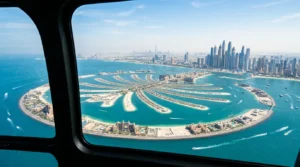
What stays the same. You will see the ground below you. Every seat is beside a window, so the view is right there, and on the way out and back you see Palm Jumeirah, the coastline and the towers from above. If you look straight down, you will feel the height.
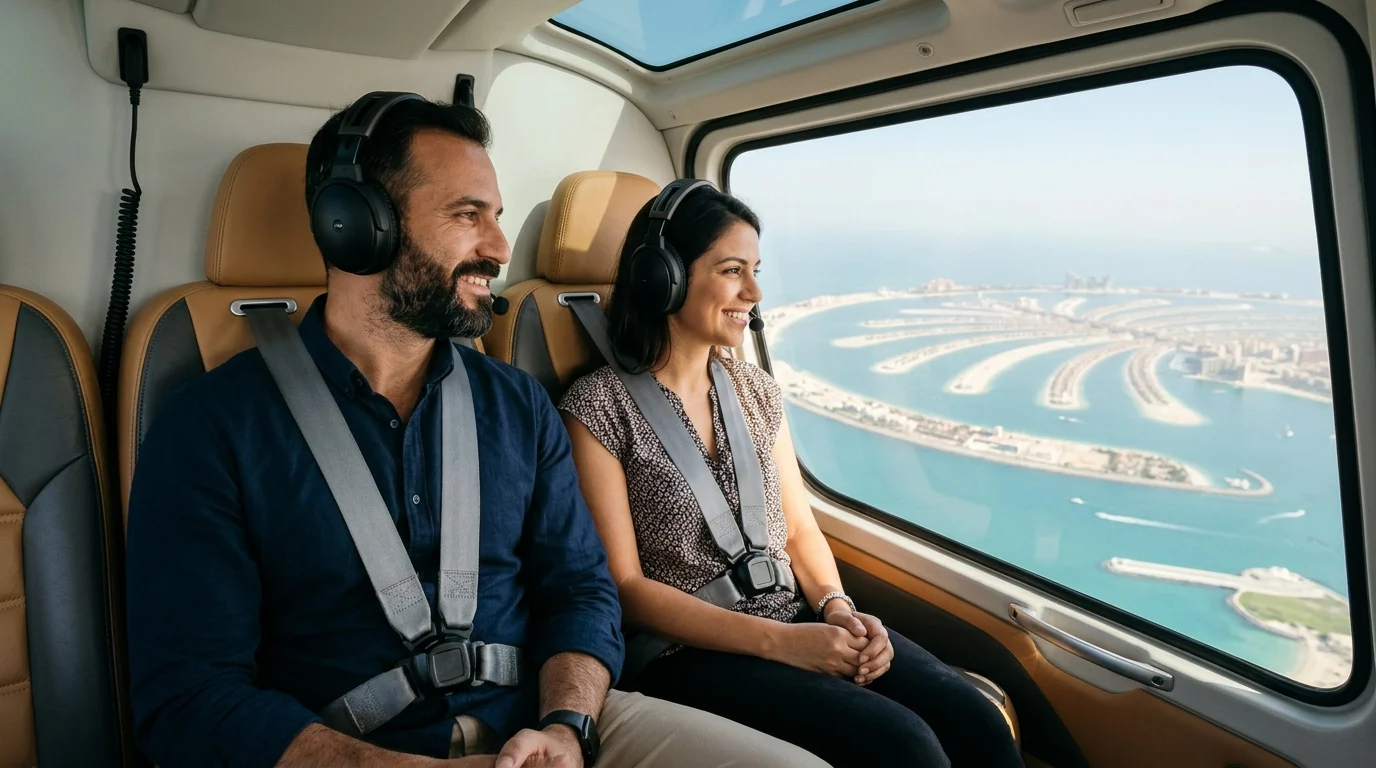
What changes. You are seated inside an enclosed cabin, not leaning over a railing. You are with other people, and on a private flight they are all your own group. A trained pilot is in control the whole time, and you can hear that pilot in your headset. The flight has a fixed length, so you know from the start when it ends.
What tends to make it worse. Rushing to the helipad, arriving late for check-in, and spending the flight staring straight down instead of at the horizon. All of these you can plan around.
Is a helicopter ride scary?
For some guests the first minute is the hardest part, and the rest of the flight feels more like watching the city move past a large window. For others, the feeling of height stays with them throughout. There is no way to know in advance which you will be, which is why the shortest route is worth considering for a first try.
Which route should a nervous flyer choose?
The six routes run from 12 to 60 minutes. For a first flight with a fear of heights, shorter is usually easier: you get the take-off, the view and the landing without a long stretch of managing your nerves.
| Route | Minutes | Shared seat (per person) | Private flight (per aircraft, up to 5 guests) | For a first flight with a fear of heights |
|---|---|---|---|---|
| City Scapes | 12 | AED 715 | AED 3,575 | The shortest test flight: Burj Khalifa, Burj Al Arab, Dubai Coastline, The Palm Jumeirah |
| Fun Ride | 15 | AED 921 | AED 4,605 | A few minutes longer, adds The World Islands and Business Bay |
| The Iconic Tour | 17 | AED 979 | AED 4,895 | Adds Atlantis The Palm, Downtown Dubai and Business Bay, still a short flight |
| City Circuit | 25 | AED 1,450 | AED 7,250 | Longer time in the air, better once you know how you react |
| The Imperial Tour | 45 | Private only | AED 14,500 | A long flight, suited to guests who already enjoy flying |
| The Gulf Desert Tour | 60 | Private only | AED 18,420 | The longest route, heads inland over the dunes |
Routes and landmarks are indicative and can vary, because the pilot in command may alter the route for safety, weather or air traffic.
What is the shortest helicopter ride in Dubai and what does it cost?
The shortest route is City Scapes, the 12-minute helicopter ride. It costs AED 715 per person on a shared flight, with up to 5 guests on board, or AED 3,575 per aircraft for a private flight for your group of up to 5 guests. The route list covers Burj Khalifa, Burj Al Arab, the Dubai Coastline and The Palm Jumeirah.
For someone unsure about heights, 12 minutes is a sensible first step: long enough to see the main landmarks, short enough to know exactly how long you need to manage.
When does a longer route make sense?
If you have flown before and felt fine, The Iconic Tour at 17 minutes for AED 979 per person shared is a natural next step. The Imperial Tour and The Gulf Desert Tour are private flights only, at AED 14,500 per aircraft and AED 18,420 per aircraft, and are better saved for when you already know you enjoy the view.
Can I ask for a seat away from the window?
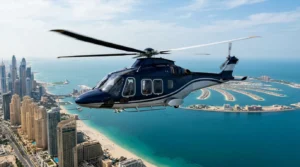
No. The fleet is Airbus H130 and H125 helicopters, carrying up to 5 passengers plus the pilot, and every passenger sits beside a window. There are no middle seats in the cabin, so a seat away from the glass does not exist. The crew also assigns seats by weight, which means the crew decides seating on the day, not the guests.
That can sound like bad news for someone who dislikes heights. In practice there are ways to live with it:
- Choose where you look. A window beside you does not mean you have to look down. Looking out towards the horizon, the sea or the line of towers often feels very different from looking straight below.
- Use the cabin as your reference. Resting your eyes on the inside of the cabin, your hands or the person next to you for a moment can help you settle before you look out again.
- Let the pilot direct your attention. When the pilot points out a landmark, look at that one thing. It gives your eyes a job and breaks the view into small pieces.
- Remember the weight rule is fixed. Shared flights allow up to 110 kg per passenger, and accurate weights are given when booking. Because seating depends on those weights, the crew may seat you away from your companion. Knowing this in advance means it will not surprise you at check-in.
Shared or private cabin: which is better for a nervous flyer?
On a shared flight, you sit with other guests who booked the same route and time. On a private flight, the whole helicopter belongs to your group of up to 5 guests.
| Point | Shared seat | Private flight |
|---|---|---|
| Who is in the cabin | Your party plus other guests | Only your own group, up to 5 guests |
| Price on City Scapes | AED 715 per person | AED 3,575 per aircraft |
| Price on The Iconic Tour | AED 979 per person | AED 4,895 per aircraft |
| Seating | Assigned by weight | Assigned by weight |
| Booking ahead | A day or two is usually fine | Three to five days ahead is advised |
On the four shared routes, a private flight costs exactly five shared seats. For a group of five, the private flight costs the same as buying five separate seats; for four, it costs one seat more. Either way you will not be sharing the cabin with strangers while you manage your nerves.
For a couple or a solo traveller, a shared seat is the lower-cost way to try.
How do you prepare beforehand?
Most of the stress around a first flight happens before you take off. Planning the day well takes a lot of it away.
Book a time window that suits you
The booking form offers three time windows: 9:00 to 11:00, 12:30 to 14:30 and 15:10 to 17:00. Pick the one where you are usually at your most relaxed. If you know you get anxious as the day goes on, the morning window lets you fly before the nerves build. Weekends, holidays and late-afternoon slots fill quickly, so book a day or two ahead for shared seats, and three to five days ahead for a private flight.
Arrive early and unhurried
Flights lift off from the helipad on Palm Jumeirah. The exact location, parking details and arrival time are sent after booking. Check in at least 45 minutes before departure for check-in, passenger weights and a short safety briefing. Arriving at the last minute is the quickest way to start a flight already tense.
To skip traffic and directions, the booking form offers an optional Private Pickup and Dropoff by private vehicle for AED 450 per car, for 5 to 6 guests per car. Pickup is 1 hour before the flight time.
Use the safety briefing
The safety briefing is included in every flight price, along with a GCAA-certified pilot, an aviation headset, and all taxes and landing fees. Treat the briefing as your time to ask anything you are unsure about. Knowing what will happen when you board, sit and land removes a lot of the guesswork that feeds anxiety.
Prepare the small things
Leave loose hats and scarves behind and secure small items, so nothing distracts you during the flight.
Does flying with a companion help?
For many people, yes. Having someone you trust in the cabin can make the flight feel shared rather than endured. Tell them beforehand what helps you: conversation, silence, or a reminder to look at a landmark.
Bear in mind that the crew assigns seats by weight, so you may not sit directly next to your companion. On a private flight, everyone in the cabin is from your own group, which removes the question of sitting beside a stranger.
What if I panic on a helicopter ride?
If a wave of fear arrives during the flight, a few things you can do in the cabin:
- Slow your breathing. Breathe in through your nose and out slowly through your mouth. A longer out-breath helps many people calm down.
- Look at the horizon or the inside of the cabin. Moving your eyes away from the view directly below often eases the feeling quickly.
- Listen to the pilot. The narration over the headset is a steady voice to focus on, and it gives your mind something to follow.
- Count the landmarks. On City Scapes there are four on the route list. Ticking them off one by one turns the flight into a sequence with a clear end.
- Remember the clock. If you chose the 12-minute route, you know the flight is short.
Plan as if your flight will run its normal route and length, and use these techniques to get through the moments that feel hard.
Do the headset and pilot narration help as a distraction?
They do for many guests. Every flight price includes an aviation headset, and the pilot narrates the route and points out landmarks as you fly. That voice in your ears does two useful things for someone with a fear of heights.
First, it gives you a clear focus: you listen for the next landmark and look for it. Second, it is a reminder that a trained, GCAA-certified pilot is in control throughout the flight.
Taking photos can help in the same way. Photos and video are welcome with devices kept inside the cabin, and framing a shot of the Burj Al Arab turns the view into a picture rather than a drop.
Helicopter ride or tower observation deck: which is easier with a fear of heights?
Some people find a seated helicopter cabin easier than standing at the glass of a tall building, and others find the opposite. The two feel different in a few ways.
At an observation deck you are standing, you can step back from the glass, and you can leave whenever you like.
In a helicopter you are seated for the whole flight, the view moves past you, and the flight has a set length. You cannot step back from the window, but you watch the city as a whole, from the coastline to the towers, rather than looking down from one point.
If you are not sure which suits you, the guide on choosing between Burj Khalifa and a helicopter ride compares the two views in more detail.
What if I change my mind before the flight?
This is the question most fear of heights guides leave out, and it matters if you are unsure. The cancellation policy follows the time before departure:
| When you cancel | Refund |
|---|---|
| 96 hours or more before departure | 100% refund |
| 48 to 96 hours before departure | 50% refund |
| Under 48 hours before departure | Non-refundable |
| Missing check-in on the day | No-show, non-refundable |
Guests may reschedule instead, subject to availability. Approved refunds reach the guest's bank account within 7 working days. The full terms are on the refund policy page.
So if you are unsure, decide early. Book more than 96 hours ahead and you keep the 100% refund window open until 96 hours before departure. Closer to the day, a reschedule is an option, subject to availability.
One thing to avoid: do not simply stay away on the day. A guest who misses check-in is a no-show, and the booking is non-refundable.
What about the weather?
The pilot in command decides whether a flight operates and may delay, alter or divert it for safety, weather or air traffic. You do not have to judge the conditions yourself.
If the company cancels for weather or a technical issue, you choose between a 100% refund or a reschedule at no extra cost. For a nervous flyer, that is useful to know: you will not be asked to fly when the pilot has decided not to operate.
Flying with children when you are the nervous one
Parents who dislike heights often worry about their own nerves and about whether the children can fly at all.
The rules are simple. Every passenger aged 2 and over needs their own paid seat. Infants under 2 cannot fly. Children aged 2 to 12 fly with an adult. A child never sits on a lap.
If you are the nervous parent, a few points help:
- Pick the shortest route. City Scapes at 12 minutes keeps the flight short for both you and the children.
- Bring a calmer adult if you can. Children aged 2 to 12 fly with an adult, and that adult does not have to be you if another adult in your group is more relaxed.
- Consider a private flight. For a family of four or five, the private price on the four shared routes is exactly five shared seats, and you will only have your own family in the cabin.
- Give children a job. Asking them to spot each landmark the pilot mentions keeps everyone looking out at the city, not down.
In short
A fear of heights does not have to keep you on the ground in Dubai. Every seat is beside a window, with no middle seats and seating assigned by weight, so plan around the view rather than hoping to avoid it. Start with City Scapes, the shortest route at 12 minutes for AED 715 per person shared or AED 3,575 per aircraft private. Book early enough to keep the 100% refund window open, arrive at least 45 minutes before departure, and use the briefing, the headset and the pilot's narration to stay focused.
When you are ready, book your flight on the booking form. For questions before you book, call +971 56 944 4804 or email [email protected].