For a Dubai sightseeing flight, the Airbus H130 and the Airbus H125 do the same job. Both carry up to 5 passengers plus the pilot from the helipad on Palm Jumeirah, every passenger sits beside a window with no middle seats, and the crew assigns seats by weight. The H130 has the wider cabin, but your route matters more.
Key takeaways
- The Dubai sightseeing routes sold on this site are flown in two helicopter types: the Airbus H130 and the Airbus H125.
- Each helicopter carries up to 5 passengers plus the pilot. Every passenger sits beside a window, with no middle seats, and the crew assigns seats by weight.
- The H130 is built around a wide cabin with large windows and an enclosed tail rotor. The H125 is one of the most widely used light helicopters for sightseeing and utility work.
- Prices are set by route and by shared seat or private flight, from AED 715 per person on the 12-minute City Scapes to AED 18,420 per aircraft for up to 5 guests on the 60-minute Gulf Desert Tour.
- Weight rules apply in both types: up to 110 kg per passenger on shared flights and up to 450 kg in total on a private flight.
- This guide does not say which type flies a given booking, so choose your flight by route, time window and seat type.
Which helicopters fly these Dubai sightseeing routes?
The six Dubai sightseeing routes sold on this site are flown in two helicopter types: the Airbus H130 and the Airbus H125. Both are light helicopters built by Airbus Helicopters, and both come from the same Écureuil family of designs, so they share a family look even though their cabins differ.
The passenger count, the window rule and the seat rule hold for every route, from the 12-minute City Scapes to the 60-minute Gulf Desert Tour.
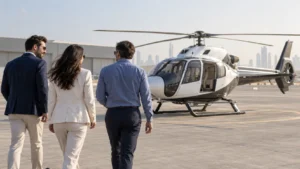
Flights lift off from the helipad on Palm Jumeirah. The exact location, parking details and arrival time are sent after booking. Each guest wears an aviation headset, and the pilot narrates the route and points out landmarks along the way.
For the wider picture of why to fly, how long to stay up and what the day looks like, the complete guide to helicopter tours in Dubai on the homepage covers the basics, including a short section on safety and the fleet. This post goes deeper into the two aircraft and what they mean for your seat, your photos and your group.
What is the Airbus H130?
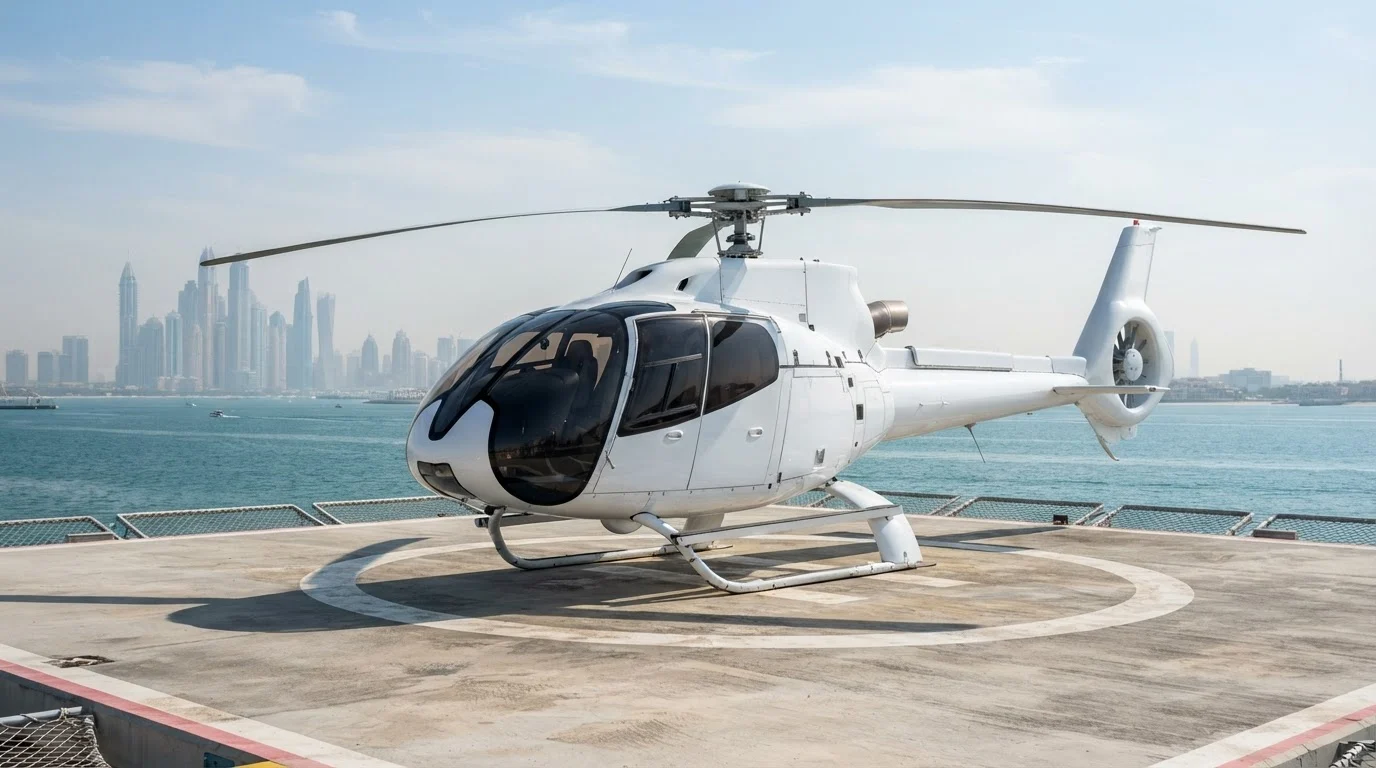
The Airbus H130 is a light helicopter that Airbus Helicopters previously sold as the EC130 T2. It grew out of the Écureuil line and was designed with sightseeing in mind. Its defining feature is a wide cabin with large windows, laid out to give passengers a broad, open view of the ground below.
The H130 is easy to recognise on a helipad. Its tail ends in an enclosed tail rotor, which Airbus calls a Fenestron: the small rotor spins inside a round duct built into the tail fin rather than out in the open. Seen from the front, the cabin also looks wider and rounder than the cabin of the H125.
Around the world, the H130 is used for scenic tours, private passenger flights and medical transport: work where people in the cabin come first.
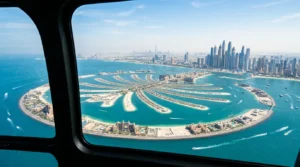
For a passenger in Dubai, the practical point is simple. Large windows suit a city whose best-known sights are spread along a coastline, from the Palm Jumeirah to Burj Al Arab, with the towers of Downtown Dubai further inland. The view on the day still depends on the route you book, the light and the flight path the pilot takes, which can vary.
What is the Airbus H125?
The Airbus H125 is the current name of the helicopter earlier known as the AS350 B3e. It belongs to the same Écureuil family, a line sold in North America as the AStar, and it is one of the most widely used light helicopter types in civil service around the world.
The H125 has a reputation as an all-rounder. Operators fly it for sightseeing, aerial filming, utility work such as carrying loads slung beneath the aircraft, and emergency services.
On a helipad, the H125 is the one with a conventional open tail rotor mounted on the side of the tail boom. Its cabin is slimmer than the cabin of the H130. Both types sit on landing skids rather than wheels, and both have a three-blade main rotor, so from a distance the tail is the easiest way to tell them apart.
Airbus H130 vs H125: how do they compare for a sightseeing flight?
The table below sets the two types side by side. The top rows are general, well-known points about each aircraft. The bottom rows are what applies to the Dubai flights sold here.
| Point | Airbus H130 | Airbus H125 |
|---|---|---|
| Earlier name | EC130 T2 | AS350 B3e (Écureuil family) |
| Cabin | Wide cabin with large windows | Slimmer, conventional cabin |
| Tail rotor | Enclosed (Fenestron) | Conventional, open |
| Best known for | Scenic tours and passenger flying | Sightseeing and utility work worldwide |
| Passengers on these flights | Up to 5 plus the pilot | Up to 5 plus the pilot |
| Window seats | Every passenger beside a window, no middle seats | Every passenger beside a window, no middle seats |
| Seat assignment | By the crew, by weight | By the crew, by weight |
| Price | Set by route and seat type | Set by route and seat type |
The rows that matter most to a passenger are the bottom four. Whichever type flies your booking, the number of guests, the window rule, the seat rule and the price list stay the same.
Is the H130 or the H125 better for Dubai flights?
On paper, the H130 is the more sightseeing-focused design, because its wide cabin and large windows were planned around passengers looking out. The H125 is the more versatile design, and its wide use in tourism shows that it handles the sightseeing job well too.
For a booking on these routes, though, the question of which type is better matters less than it looks. Both types carry the same group size, both seat every passenger beside a window, and the price is the same whichever one flies. The things that shape your flight more are:
- The route. The 12-minute City Scapes focuses on the Palm, Burj Al Arab and the coastline, with Burj Khalifa on its list. The 17-minute Iconic Tour is the shortest route that pushes inland to bring Downtown Dubai and Burj Khalifa into the window. The longer routes add more of the city.
- The time window. The booking form offers 9:00 to 11:00, 12:30 to 14:30 and 15:10 to 17:00, and the light changes across the day.
- Shared seat or private flight. A private flight gives your group the whole cabin, which makes a bigger difference to most groups than the airframe does.
- Your seat. The crew assigns seats by weight, so where you sit depends on the balance of everyone on board.
- The pilot's call. The pilot in command decides whether a flight operates and may delay, alter or divert it for safety, weather or air traffic. Routes and landmarks are indicative and can vary.
Which of the two types flies a particular booking is not something this guide can tell you. If the aircraft matters to you, for example because you have a strong interest in one type, ask the team on +971 56 944 4804 by phone or WhatsApp, or at [email protected], before you book. Then make your choice on the route.
Will you get a window seat?
Yes. On these flights every passenger sits beside a window, and there are no middle seats. That holds in both the H130 and the H125, on shared seats and private flights alike.
What you cannot choose is which window. The crew assigns seats by weight once every passenger's weight is known. A helicopter has to be loaded in balance, front to back and side to side, so the crew places each passenger where the overall load works best.
This has a few practical consequences:
- Give accurate weights when you book. The booking asks for them, and check-in includes passenger weights.
- Do not plan around a particular seat. A request for one side of the cabin or one position cannot be promised.
- Expect company on a shared flight. You may sit beside guests from another booking. Everyone still has a window.
- Trust the narration. Both sides of the cabin see the city, and the pilot points out landmarks so you know where to look.
What do the windows mean for photos and video?
Photos and video are welcome on these flights, with devices kept inside the cabin. In practice that means you shoot through the glass, so a little preparation pays off.
- Keep the lens close to the glass. Holding the phone or camera near the window, without pressing hard against it, cuts reflections from inside the cabin.
- Turn the flash off. A flash bounces off the window and lights up the glass, not the city.
- Secure everything. Leave loose hats and scarves behind and secure small items. A wrist strap on a phone or camera helps.
- Charge and clear space first. Battery and storage run down quickly when you film a flight from start to finish.
- Watch as well as film. On a 12-minute or 15-minute route the time passes quickly. Film part of the flight, then put the device down and look.
The window you get depends on the crew's seat plan, so either side of the city may be the one in front of you. The narration helps you pick the moment. For the routes themselves, the page with all six Dubai helicopter routes compared lists what each one passes.
How does a private flight work for a group of 2 to 5?
A private flight gives the whole helicopter to your group of up to 5 guests. It is priced per aircraft, not per person, and it carries up to 450 kg in total. The cabin is yours, route wishes are discussed when booking, and departure times follow the same three booking windows as shared flights.
On the four routes that also sell shared seats, a private flight costs exactly five shared seats. The 45-minute Imperial Tour and the 60-minute Gulf Desert Tour are private flights only. The table shows every flight price on the booking form, with its unit.
| Route | Duration | Shared seat | Private flight (up to 5 guests) |
|---|---|---|---|
| City Scapes | 12 minutes | AED 715 per person | AED 3,575 per aircraft |
| Fun Ride | 15 minutes | AED 921 per person | AED 4,605 per aircraft |
| The Iconic Tour | 17 minutes | AED 979 per person | AED 4,895 per aircraft |
| City Circuit | 25 minutes | AED 1,450 per person | AED 7,250 per aircraft |
| The Imperial Tour | 45 minutes | Private only | AED 14,500 per aircraft |
| The Gulf Desert Tour | 60 minutes | Private only | AED 18,420 per aircraft |
Prices are set by route and by shared seat or private flight. The price list has no separate line for each aircraft type, so the type does not change what you pay.
A few points shape a group booking:
- Count every guest aged 2 and over. Every passenger aged 2 and over needs their own paid seat, children included. Infants under 2 cannot fly.
- Children fly with an adult. Children aged 2 to 12 fly with an adult.
- Add up weights early. A private flight carries up to 450 kg in total, so check your group's combined weight before you choose private.
- Book ahead. Book private flights and special occasions three to five days ahead.
For the full pricing logic, including when the whole cabin makes more sense than separate seats, read private helicopter ride prices in Dubai: seats or the whole aircraft.
How do the weight rules relate to the aircraft?
Weight rules exist because every helicopter has a limit on what it can carry and on how that load is spread through the cabin. The rules here are the same whichever type flies your booking:
- Shared flights: up to 110 kg per passenger. A heavier guest may need to buy an extra seat.
- Private flights: up to 450 kg in total for the group.
- Booking: accurate weights are given when booking, and check-in includes passenger weights.
- Seating: the crew uses those weights to assign seats.
Honest numbers help everyone on board. Accurate weights let the crew plan seats and balance before the flight, which keeps check-in smooth for your group and for any guests sharing the cabin.
Other passenger rules sit alongside the weight limits. Expectant mothers may fly up to 32 weeks, and medical clearance is advised. Guests with reduced mobility are welcome with a companion who can help with boarding. The post on weight, age and pregnancy rules explains each rule in more detail, and the full wording is in the terms and conditions.
What does every flight include, in either aircraft?
The inclusions do not depend on the helicopter type. Every flight price includes:
- a pilot with GCAA certification;
- an aviation headset;
- the safety briefing before departure;
- all taxes and landing fees.
Hotel transfers cost extra. The booking form offers an optional Private Pickup and Dropoff by private vehicle at AED 450 per car, with 5 to 6 guests per car. Pickup is 1 hour before the flight time. Without it, you make your own way to the helipad on Palm Jumeirah using the details sent after booking.
What happens on the day, from check-in to lift-off?
The routine is the same in the H130 and the H125.
- Arrive early. Check in at least 45 minutes before departure. Check-in covers passenger weights and a short safety briefing.
- Leave restricted items behind. Hazardous materials, weapons, flammable liquids and outside food or drink are not allowed on board.
- Take your seat. The crew assigns seats by weight, and you put on your aviation headset.
- Fly and listen. The pilot narrates the route and points out landmarks. Keep phones and cameras inside the cabin.
A guest who misses check-in is a no-show, and the booking is non-refundable. Leave room in your travel time, especially if you are driving yourself and need to park.
What if the weather or a technical issue stops the flight?
The pilot in command decides whether a flight operates. That decision is about safety, weather and air traffic, and it applies in both aircraft types. A flight may be delayed, altered or diverted.
If the company cancels for weather or a technical issue, guests choose a 100% refund or a reschedule at no extra cost. Approved refunds reach the guest's bank account within 7 working days.
If you cancel yourself, the refund policy applies:
- 96 hours or more before departure: 100% refund.
- 48 to 96 hours before departure: 50% refund.
- Under 48 hours before departure: non-refundable.
Guests may reschedule instead, subject to availability.
Planning advice: what to decide before you book
Use this order, which puts the decisions that change your flight first.
- Choose the route. Decide how much of Dubai you want to see, from the 12-minute City Scapes to the 60-minute Gulf Desert Tour.
- Choose shared seat or private flight. Shared seats are priced per person. Private flights are priced per aircraft for up to 5 guests.
- Choose a time window. Pick 9:00 to 11:00, 12:30 to 14:30 or 15:10 to 17:00.
- Collect ages and weights. Every guest aged 2 and over needs a paid seat, infants under 2 cannot fly, and accurate weights are given when booking.
- Book with enough lead time. A day or two ahead is usually fine for shared seats. Weekends, holidays and late-afternoon slots fill quickly. Book private flights three to five days ahead.
- Decide on the transfer. Add the Private Pickup and Dropoff at AED 450 per car if you want a ride to the helipad.
- Ask about the aircraft last. If the type still matters to you, ask the team before you pay.
Choosing your flight
The Airbus H130 and the Airbus H125 are close relatives with different strengths. The H130 is the wide-cabin sightseeing design with an enclosed tail rotor. The H125 is the versatile all-rounder flown around the world. On these Dubai routes, both carry up to 5 passengers plus the pilot, both seat every passenger beside a window, and the crew assigns seats by weight in both.
That makes the route, the time window and the choice between a shared seat and a private flight the decisions worth your attention. When you have made them, book your Dubai helicopter flight on the booking form. For questions about the fleet before you book, call or WhatsApp +971 56 944 4804.