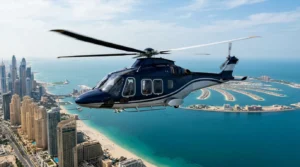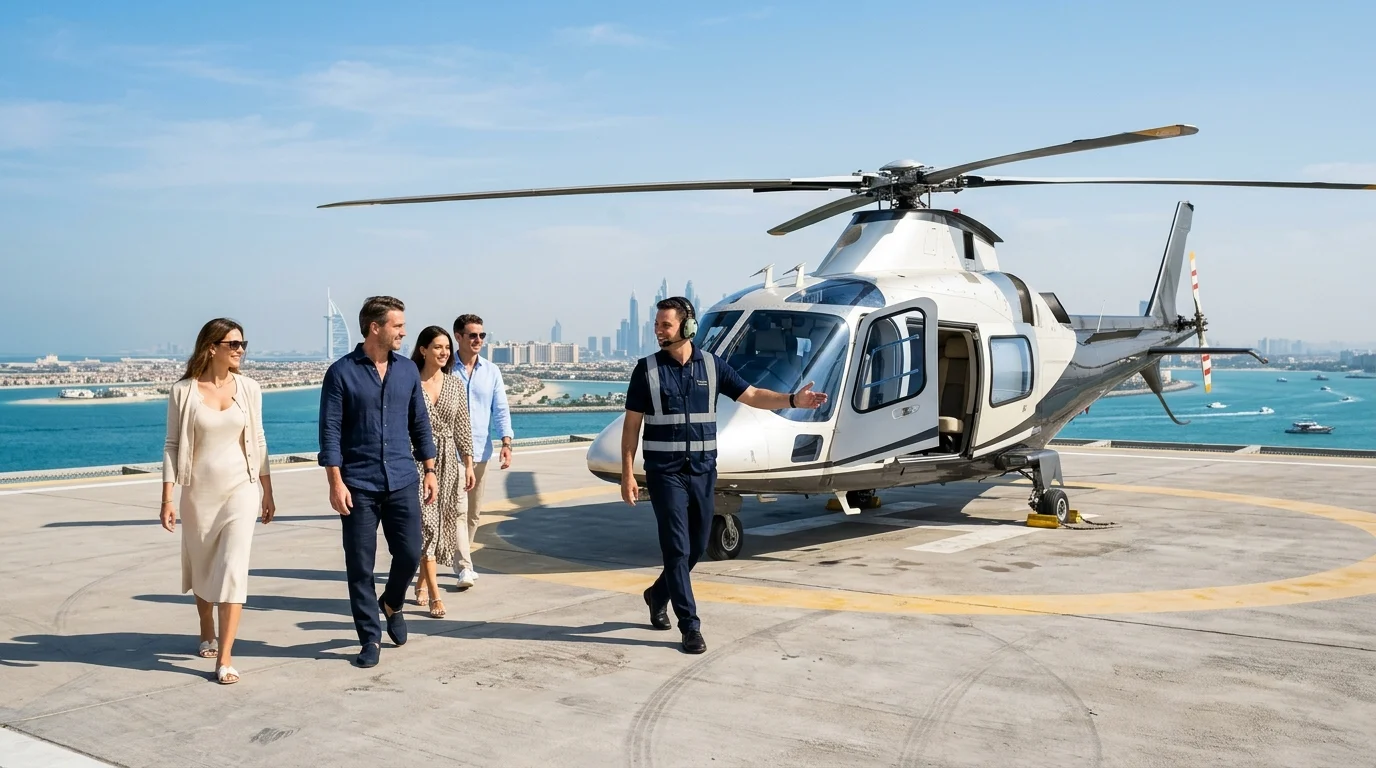
Helicopter tours ask for your weight because a helicopter has to carry a known total load, spread evenly around the cabin. At Luxury Helicopter Tours Dubai, shared flights allow up to 110 kg per passenger, a private flight carries up to 450 kg in total, and the crew uses everyone's weight to decide who sits where.
Key takeaways
- Your weight is asked for when you book, and passenger weights are taken again at check-in, at least 45 minutes before departure.
- Shared flights allow up to 110 kg per passenger. A heavier guest may need to buy an extra seat.
- A private flight carries up to 450 kg in total for the whole group of up to 5 guests.
- The crew assigns seats by weight, so couples and friends may not sit side by side.
- Every passenger sits beside a window on the Airbus H130 and H125, with no middle seats, so no seat is a bad seat for views.
- Children aged 2 to 12 fly with an adult and need their own paid seat, and their weight is part of the total like everyone else's.
Why do helicopter tours need your weight?
A helicopter is a small aircraft with a limited amount of space for people and a limited amount of load it is planned to lift. On a big passenger plane, a few heavier or lighter travellers make very little difference. In a cabin built for up to 5 passengers plus the pilot, each person is a large share of the whole.
Two things matter, and both are simple ideas.
The first is the total. The crew needs to know how much the people on board weigh together, so the flight can be planned with a load the aircraft is meant to carry. That is why the company sets a per-passenger figure for shared flights and a total figure for private flights.
The second is balance. A helicopter flies best when the weight inside is spread sensibly, not piled up on one side or at one end of the cabin. Think of carrying a tray of drinks: the same number of glasses is easier to hold steady when they sit evenly across it. Seating people by weight is how the crew keeps that tray level.
Neither of these is about judging anyone. It is the same reason a small boat asks people to spread out before it leaves the dock. The numbers simply let the crew plan the flight properly before anyone climbs in.
Why accuracy matters more than you might think
Because the plan is built on the weights you give, a guess that is well off can mean the seating has to be changed on the day. That can slow down check-in for the whole group on a shared flight. The facts are clear on this point: accurate weights are given when booking. Use a recent, honest figure, and include what you will be wearing and carrying in your pockets if you are close to a limit.
When do they ask, and do they weigh you at the helipad?
Weight comes up twice in the booking process, and knowing both steps removes most of the surprise.
At booking
The booking form asks for passenger details, and accurate weights are given at this stage. For a group, you will be entering a weight for each guest, so it helps to collect those numbers from everyone before you start the form. This is also the moment to think about the 110 kg shared limit, because choosing the right type of flight now is far easier than changing it on the day.
At check-in
Check-in is at least 45 minutes before departure. That time covers check-in itself, passenger weights and a short safety briefing. In other words, weights are confirmed at the helipad as part of the normal routine, for every guest, not as a special step for some people.
If you are worried about being weighed with other guests nearby, it helps to know that this is simply part of check-in for everyone on every flight. If you would like to raise a question about your weight before the day, the team can be reached by phone or email through the contact details on the site, and it is better to ask early than to arrive unsure.
What happens if you arrive late
The 45-minute check-in is not padding. A guest who misses check-in is treated as a no-show, and that booking is non-refundable. Since weights and seat planning happen during check-in, arriving late does not just mean a rush; it can mean missing the flight altogether. Plan your drive to Palm Jumeirah with that in mind, and remember that the exact helipad location, parking details and arrival time are sent after booking.
How does seat assignment by weight work?
The fleet is Airbus H130 and H125 helicopters carrying up to 5 passengers plus the pilot. The crew assigns seats by weight. Once the weights for that flight are known, the crew decides who sits where so the load is spread the way it should be.
You do not pick your seat on arrival, and that is deliberate. A seating plan that suits one group of guests might not suit the next, because the mix of weights changes every flight. On a shared flight, where you may be flying with people you have never met, the crew has to work with everyone's numbers together.
If you want more detail on how shared seats fill and how flights are grouped, the guide to how seats and flights work on a shared helicopter tour walks through it step by step.
Can I sit next to my partner?
Not always. Because the crew assigns seats by weight, couples, friends and family members may be placed apart if that gives the cabin a better spread. It is worth expecting this rather than being caught off guard at the helipad.
In a cabin this small, though, "apart" still means a few seats away in the same space, sharing the same flight and hearing the same narration through your aviation headsets. The pilot narrates the route and points out landmarks, so you will both hear what you are looking at, even if you are not shoulder to shoulder.
If sitting together matters a great deal, for a proposal, an anniversary or a nervous first flyer who wants a familiar face close by, a private flight is the cleaner option. Your group fills the whole aircraft, so the crew is only balancing your own people, and you can ask about seating when you book. The crew still has the final say on seating, but you are no longer being mixed with other guests' weights.
Is any seat a bad seat?
This is the question that worries people most once they learn they cannot choose. On the Airbus H130 and H125, every passenger sits beside a window, and there are no middle seats. Whichever seat the crew gives you, you have glass next to you and a view out.
That is the main reason seat assignment by weight is far less of a trade-off than it sounds. You are not being moved from a good seat to a poor one; you are being moved from one window to another. Keep your phone or camera ready from the moment you lift off, because the coastline, the towers and The Palm Jumeirah can appear on either side as the route turns.
Remember too that routes and landmarks are indicative and can vary, and the pilot in command may alter a flight for safety, weather or air traffic. The view from each side depends on the route flown on the day, not on which seat number you were given.
What if I am over 110 kg?
Shared flights allow up to 110 kg per passenger. A heavier guest may need to buy an extra seat. Accurate weights are given when booking, so the team can tell you before the day whether a second seat is needed.
If a second seat is needed, it is a second seat at that route's shared seat price. On City Scapes, for example, the shared seat price is AED 715 per person, so that is the rate to plan around. The team confirms the cost of any extra seat when you book.
The honest advice is simple: if you are at or above 110 kg, mention it when you book or contact the team first. Sorting it out at booking means your seats are planned properly, and you avoid any change to the plan at check-in.
Shared seat or private flight for a heavier passenger?
For some guests, a private flight is the more comfortable answer. On the four shared routes, a private flight costs exactly five shared seats, and the 450 kg total applies to the group as a whole rather than 110 kg to each person. That gives a group more room to balance weights between its own members.
Here is how the two options sit side by side on every route.
| Route | Shared seat (AED per person) | Private flight (AED per aircraft, up to 5 guests) | Second seat if one is needed |
|---|---|---|---|
| City Scapes, 12 minutes | AED 715 per person | AED 3,575 per aircraft | At the shared seat price, AED 715 per person |
| Fun Ride, 15 minutes | AED 921 per person | AED 4,605 per aircraft | At the shared seat price, AED 921 per person |
| The Iconic Tour, 17 minutes | AED 979 per person | AED 4,895 per aircraft | At the shared seat price, AED 979 per person |
| City Circuit, 25 minutes | AED 1,450 per person | AED 7,250 per aircraft | At the shared seat price, AED 1,450 per person |
| The Imperial Tour, 45 minutes | Private flight only | AED 14,500 per aircraft | Not applicable, private flight only |
| The Gulf Desert Tour, 60 minutes | Private flight only | AED 18,420 per aircraft | Not applicable, private flight only |
Every price includes a GCAA-certified pilot, an aviation headset, the safety briefing before departure, and all taxes and landing fees. Hotel transfers cost extra: private pickup and dropoff by private vehicle is AED 450 per car, for 5 to 6 guests per car, chosen on the booking form.
A few points help with the choice:
- One heavier guest in a small group. If you are two or three people and one of you may need a second seat, compare the shared total with the private price for that route. The table gives you the figures to do that at a glance.
- A group of four or five. Here a private flight often makes more sense, because you are already close to filling the aircraft. The post on booking a helicopter ride for four people compares both options for that group size.
- The longer routes. The Imperial Tour and The Gulf Desert Tour are private flights only, so the 450 kg total is the figure that applies.
You can read more about what a private booking includes on the private helicopter tour page.
Does a private flight have a weight limit?
Yes. A private flight carries up to 450 kg in total, and it seats up to 5 guests. The limit is for the whole group combined, not per person.
How a group of five adds up against 450 kg
A quick way to think about it: if five guests share 450 kg, their average works out at 90 kg each. That does not mean every person must weigh 90 kg or less. It means the group's weights added together need to come in at or under 450 kg.
So a group with one guest above the average and others below it can still fit, as long as the combined number stays within the total. Before you book, add up everyone's weight. If the total sits comfortably under 450 kg, a party of five fits on one private flight. If it comes out above, you may need to fly fewer people on that aircraft and talk to the team about how to split your group.
Smaller groups on a private flight
A private flight is priced per aircraft whether you bring two guests or five. A couple or a group of three on a private flight has the whole cabin to themselves. For a pair, the main reasons to go private are sitting together and having the cabin to yourselves, rather than the weight limit.
Do children's weights count?
Yes. Every passenger aged 2 and over needs their own paid seat, and every passenger's weight is part of the load the crew plans for. A child is never an add-on in the cabin; they are a passenger with a seat, a headset and a place in the seating plan.
The rules for families are clear in the facts:
- Infants under 2 cannot fly.
- Children aged 2 to 12 fly with an adult.
- Every guest aged 2 and over needs a paid seat. A child cannot sit on a lap.
On a shared flight, a child's lighter weight is simply part of the overall picture the crew works with. On a private flight, children count toward the 450 kg total like everyone else, which often makes a family of five easier to fit than five adults.
Because the crew assigns seats by weight, a child may not be seated directly beside their parent. They will still be in the same small cabin, beside a window, and flying with an adult as the rules require. If this worries you, ask about seating when you book. Telling younger flyers in advance that they may sit by a different window, with their own headset, usually makes the moment at check-in much easier.
Other passenger points that sit alongside weight
Weight is one part of a short list of passenger details the team needs. The others are worth knowing at the same time, so you can fill in the booking form once and correctly.
- Pregnancy. Expectant mothers may fly up to 32 weeks, and medical clearance is advised.
- Reduced mobility. Guests with reduced mobility are welcome with a companion who can help with boarding.
- What stays on the ground. Hazardous materials, weapons, flammable liquids and outside food or drink are not allowed on board. Leave loose hats and scarves behind and secure small items.
- Cameras. Photos and video are welcome with devices kept inside the cabin.
The full set of passenger rules, including age and pregnancy, is gathered in the post on weight, age and pregnancy rules, and the site's FAQ covers the most common questions in short form.
Planning your booking around weight
A little preparation turns weight from an awkward subject into a five-minute task.
Before you book
- Collect accurate weights for everyone. Ask each guest for a recent, honest figure. For children, use their current weight, not last year's.
- Check each person against 110 kg if you plan to fly shared. If anyone is at or above it, raise it at booking so the team can tell you whether a second seat is needed.
- Add up the group total if you plan to fly private. Compare it with the 450 kg limit for the aircraft.
- Decide how much sitting together matters. If it matters a lot, lean toward a private flight, where only your own group is being balanced.
- Pick your time window. The booking form offers three: 9:00 to 11:00, 12:30 to 14:30 and 15:10 to 17:00.
How far ahead to book
A day or two ahead is usually fine for shared seats, though weekends, holidays and late-afternoon slots fill quickly. Book private flights and special occasions three to five days ahead. If you think a second seat may be needed, give yourself a little more time.
On the day
- Arrive for check-in at least 45 minutes before departure. Passenger weights and the safety briefing happen in that window.
- Wear what you planned to wear when you gave your weight, and keep bags and loose items to a minimum.
- Follow the crew's seating plan. It is built from everyone's numbers, and every seat is beside a window.
If plans change
Cancellation follows the refund policy: 96 hours or more before departure, 100% refund; 48 to 96 hours, 50% refund; under 48 hours, non-refundable. Guests may reschedule instead, subject to availability. If the company cancels for weather or a technical issue, guests choose a 100% refund or a reschedule at no extra cost, and approved refunds reach the guest's bank account within 7 working days.
In short
Helicopter tours ask for your weight because a small aircraft needs a known total load, spread evenly around the cabin. In Dubai, that means up to 110 kg per passenger on shared flights, up to 450 kg in total on a private flight, weights given at booking and confirmed at check-in, and seats assigned by the crew. Since every seat on the Airbus H130 and H125 sits beside a window, being moved for balance never costs you the view.
If you have your group's weights ready and know which route you want, you can choose a shared seat or a private flight and give everyone's details on the booking form.